Why Does My Dog Stare at Me? What That Look Really Means
Those big eyes, fixed on you across the room, following your every move. Adoration? Hunger? A desperate need for the garden? Let's translate the dog stare.
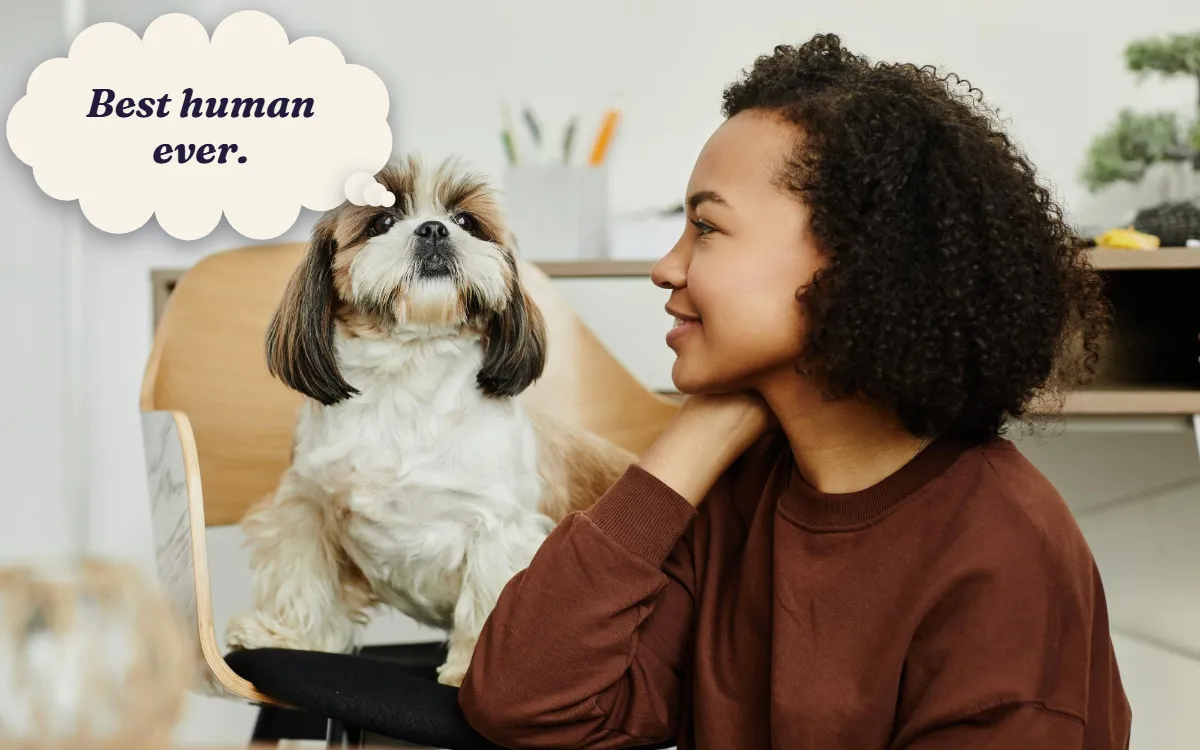
Dogs stare at you mainly to seek attention, food or a cue, and to strengthen their bond with you. That soft-eyed gaze actually releases oxytocin, the love hormone, in both dog and owner. Most staring is affectionate and communicative. A stiff, hard stare with a tense body is the rare exception that signals a warning.
Does my dog stare at me because they love me?
Genuinely, yes, and there is real science behind it. Research has shown that when dogs and their owners gaze into each other's eyes, both experience a rise in oxytocin, the same bonding hormone involved in the connection between parents and babies. This gaze-driven loop is thought to be one of the reasons dogs and humans bond so deeply, and it is largely unique to domesticated dogs. Wolves, even hand-raised ones, do not do it in the same way.
So when your dog settles down and looks at you with soft, relaxed eyes and a loose, wiggly body, they are quite literally topping up the love hormone for both of you. It is one of the sweetest things they do, and it is completely mutual. Curious what is behind your dog's gaze right now? You can scan them free and get their thoughts in about ten seconds.
Is my dog staring because they want food or attention?
Very likely. Dogs are expert observers of the people who control the resources they care about, and staring is one of their most reliable tools. If gazing at you has ever produced a treat, a scratch behind the ears or a game, your dog has learned that staring works. Round the dinner table this becomes a fine art, as many dogs will fix you with a soulful, unwavering look designed to make you crumble.
Signs the stare is a request include:
- Glancing between you and their bowl, the lead, or the biscuit tin
- A little whine, paw lift or nudge alongside the look
- Perfect timing around meals, walks or your usual cuddle slot
- Tail movement and an eager, hopeful expression
This is not bad behaviour, it is communication. Just be mindful that rewarding the stare with food every single time teaches them to keep asking, so it is fine to set gentle boundaries around begging.
Why does my dog stare at me and wait?
A lot of staring is your dog awaiting a cue. Dogs that have done any training learn to watch their humans closely for the signal that tells them what happens next. A dog sitting alert, eyes locked on you, ears forward, is often saying what are we doing, what is the plan, tell me the word and I will do the thing. This is attentive, eager engagement and it is exactly what you want in a dog that is tuned in to you.
You will see this most in dogs bred to work alongside people, such as collies, retrievers and shepherds. Their watchfulness is a feature, not a fault, though it does mean they need plenty of mental stimulation to feel satisfied.
Why does my dog stare at me blankly and not listen?
Sometimes the stare is not adoration or anticipation, it is confusion. If you give a cue and your dog just looks at you, frozen and blinking, the most likely explanation is that they do not understand what you are asking in that moment. This is easily mistaken for stubbornness, but dogs are rarely being defiant. More often the word has not been trained thoroughly, the environment is too distracting, or they are a little overwhelmed.
The fix is patience rather than frustration. Break the task down, reward the smallest step in the right direction, and practise in a calm, low-distraction setting before expecting the same response in a busy park. A confused dog who is helped to succeed becomes a confident, responsive one.
Could my dog need the loo?
Yes, and it is worth ruling this out early, especially with a sudden, insistent stare. Many dogs learn to communicate a full bladder by fixing their human with a meaningful look, sometimes drifting toward the back door and glancing back to check you are following. If the staring is accompanied by pacing, circling, restlessness or heading to the exit, take the hint and open the door.
Puppies and older dogs in particular may give you very little warning, so a pointed stare might be the polite version of an urgent request. Responding promptly also reinforces that this is a brilliant way to communicate, which helps toileting habits no end.
Why does my dog tilt its head when they stare?
The head tilt is one of the most charming things dogs do, and it usually signals a switched-on, engaged dog. There are a few likely reasons working together. Tilting the head may help your dog pinpoint the source and meaning of a sound, adjust their view of your face past their own muzzle, and pick familiar words like walk or dinner out of a sentence. Studies suggest dogs that tilt more often may be especially good at learning the names of objects.
In short, a head tilt during a stare is a sign your dog is really listening and trying to understand you. It is engagement, not bafflement, and it is thoroughly earned adoration when you tilt your head back. Want to know exactly what that tilt means for your dog? Scan your dog free and see.
When is a dog's stare a warning sign?
This is the one context where a stare should be taken seriously. A hard stare is very different from a loving gaze, and learning to tell them apart keeps everyone safe. A warning stare tends to come with a stiff, frozen body, a tense closed mouth, ears pinned or held rigid, and often whale eye, where you can see the whites at the edges of the eyes. The whole dog looks tight and coiled rather than soft and loose.
You are most likely to see this around resources, such as food, a favourite toy, a bone or a resting spot. This is resource guarding, an instinct to protect something valuable, and the hard stare is a polite early warning that says please do not come closer. The right response is to give the dog space and never to punish the warning, since punishing it only teaches a dog to skip the warning next time. If your dog shows guarding or hard-staring behaviour, a qualified, reward-based behaviourist can help enormously. Read the whole body, and when in doubt, back off and give them room.
Frequently asked questions
Why does my dog stare at me all the time?
Most constant staring is your dog seeking connection, attention or information. Dogs read us closely because we control the good stuff, from meals to walks to affection. Soft eyes and a relaxed body mean it is a loving, attentive stare rather than anything to worry about.
Is it good when my dog stares at me?
Usually yes. A soft-eyed, loose-bodied stare is often a bonding gaze that releases oxytocin in both of you. The exception is a hard stare with a stiff body, whale eye, a closed tense mouth or a freeze, which is a warning to give the dog space.
Why does my dog stare at me while eating or with a toy?
That can be resource guarding, where the dog is watching to check you are not about to take something valuable. A stiff body and hard stare over food or a toy should be taken seriously and is worth support from a qualified behaviourist.
Why does my dog stare at me and not listen?
A dog who stares blankly after a cue is often confused rather than stubborn. They may not understand the word, be distracted, or find the environment too stimulating. Simplify the cue, reward small wins, and train in a calmer setting.
Why does my dog tilt its head when staring at me?
The head tilt usually means your dog is engaged and processing. It may help them hear and locate sounds, see your face past their muzzle, and pick out familiar words. It is a sign of a switched-on, attentive dog rather than confusion.
Stop guessing. Find out what your pet is really thinking.
Our free AI Pet Mind Reader reads their face and tells you what is going on in there - in about 10 seconds, no sign-up.
Scan my pet free