What Do Dogs Think About All Day? (The Science + What Yours Is Thinking)
While you are at work picturing your dog quietly missing you, what is actually going on in that fluffy head? The honest, science-backed answer is lovelier than you might expect.
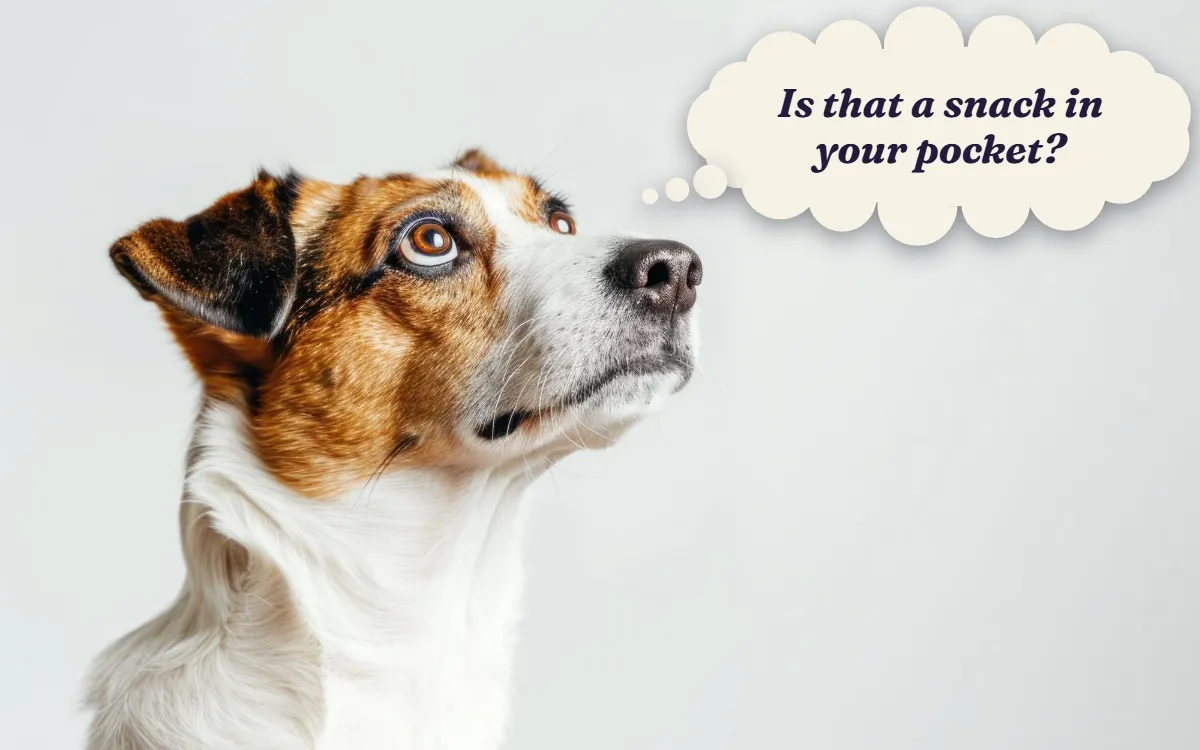
Dogs think mostly about smells, food, routine, rest and the people they love, all filtered through a sensory world dominated by scent rather than words. They form attachments, remember experiences, track time loosely through habit and smell, and almost certainly dream. In short, a big part of what your dog thinks about all day is you.
What does science actually know about how dogs think?
Dog cognition has become a serious field of study, with research labs around the world running gentle experiments to understand the canine mind. The consensus is that dogs are genuinely intelligent, emotionally rich animals, though they think differently from us. The average dog is often compared to a human toddler of around two years old in some cognitive measures, capable of understanding roughly 150 words or more, basic counting, and simple problem solving.
Crucially, dogs evolved alongside humans for tens of thousands of years, and a lot of their mental machinery is tuned to reading and cooperating with us. They are unusually good at following human pointing and eye gaze, picking up our emotional states, and learning what our routines mean for them. So while we cannot climb inside a dog's head, we can say with confidence that their thinking is social, sensory and firmly rooted in the present. Curious what is on your own dog's mind right now? You can scan them free in about ten seconds.
Do dogs think in words or images?
Dogs do not have an inner verbal monologue the way people do. They are not sitting there narrating their day in sentences. Instead, their thinking is believed to be built from sensory impressions, emotions and learned associations. When your dog hears the word walk, they are not parsing grammar, they are lighting up with a bundle of images, feelings and anticipations, such as the lead, the door, the smells outside, the joy of it all.
Smell deserves special mention, because for a dog the world is arguably built out of scent as much as sight. It is entirely possible that a good deal of dog thought happens in what we might loosely call smell-pictures, a rich olfactory memory and imagination we can barely conceive of. Their brains devote a vast proportion of processing power to the nose, so a dog thinking about you may well be thinking, in part, about how you smell.
Do dogs understand time passing?
Not in the clock-watching sense, but far from cluelessly either. Dogs track time through several channels working together:
- Routine, since regular feeds, walks and your comings and goings create a reliable rhythm
- Their body clock, the internal circadian sense of day and night
- Hunger and other physical cues that build predictably through the day
- Light levels changing through morning, afternoon and evening
- Scent, which is a fascinating one, as your smell in the home fades in a predictable way after you leave
That last point is genuinely intriguing. Some researchers suggest dogs may gauge how long you have been gone partly by how much your scent has faded, which could help explain why a dog greets you differently after a quick trip to the shops versus a full working day. They do not know it is 5pm, but they have a decent sense of roughly how long is a long time.
What occupies a dog's mind most of the day?
If we could sample a dog's thoughts across a typical day, a few themes would dominate. Rest is a big one, as dogs sleep a great deal, often twelve to fourteen hours a day, which is completely normal and healthy. Around that rest, their waking mind orbits a handful of favourite subjects.
- Smells. Investigating, cataloguing and enjoying scent is a huge part of a dog's mental life, whether it is the trail across the garden or who has walked past the front gate.
- Food. The next meal, dropped crumbs, the treat cupboard, the exact sound of the fridge door. Food looms large.
- Routine and anticipation. Dogs love knowing what comes next, and much of their thinking is a quiet forecast of the day's familiar events.
- You. Their humans are the centre of a domestic dog's world, the source of safety, food, walks and affection.
- Comfort and safety. Feeling warm, secure and relaxed is a genuine mental state dogs seek out, not just a physical one.
It is a simpler mental world than ours in some ways, but a deeply contented one when a dog's needs are met.
Do dogs think about us when we are gone?
This is the question every owner really wants answered, and the evidence is heartening. Dogs form strong, lasting attachments to their people, comparable in some respects to the bond between a child and parent. Brain imaging studies have shown that the scent of a familiar human lights up the reward centres of a dog's brain, more so than other scents. In other words, you smell like happiness to your dog.
Dogs clearly remember us, recognise us instantly after long absences, and show a measurable surge of the bonding hormone oxytocin when reunited with their owners. Put together, it is entirely fair to say that yes, your dog thinks about you while you are out, holds your scent and image in mind, and experiences real joy when you return. That desperate wiggly welcome at the door is not just habit, it is love. Want to peek inside that devoted little mind? Scan your dog free and find out what they are thinking.
Do dogs dream, and what about?
Almost certainly, they do. Dogs experience the same broad sleep stages we do, including REM sleep, the phase most strongly associated with vivid dreaming in humans. If you have ever watched your dog's paws paddle, whiskers twitch, or heard little muffled woofs while they sleep, you have very likely caught them mid-dream.
Researchers believe dogs, like people, tend to dream about their everyday experiences. So a dog's dreams probably feature the ordinary joys of dog life: running, chasing, playing, exploring smells, and being with their favourite humans. Interestingly, studies suggest smaller dogs may dream more frequently in shorter bursts, while larger dogs have longer, less frequent dreams. Whatever the pattern, it is a comforting thought that your dog may be replaying a happy walk or a good game while they snooze at your feet.
So what is your dog really thinking?
The big picture is warm and reassuring. Your dog lives largely in a rich, sensory, mostly happy present, thinking in smells and feelings rather than words, anchored by routine, motivated by food and comfort, and centred emotionally on you. They remember you, miss you in their own way, dream about their day, and greet your return as the best thing that has happened. It is a beautiful little mind, and it thinks about you far more than you might have dared to hope.
Frequently asked questions
Do dogs think in words or images?
Dogs do not think in language the way we do, but they clearly understand many words and associate them with meaning. Their thinking is believed to lean heavily on sensory information, especially smell, along with images, emotions and learned associations rather than an inner verbal monologue.
Do dogs think about their owners when we are gone?
Evidence suggests they do. Dogs form strong attachments, remember us, and show measurable excitement and oxytocin release on our return. Studies indicate they can hold our scent and image in mind, so it is reasonable to say your dog thinks about you while you are out.
Do dogs understand time passing?
Not by reading a clock, but dogs track time through routine, light, hunger, and their body clock, and research suggests scent may help too, as your fading smell through the day can signal how long you have been gone. They notice the difference between a short trip and a long absence.
What occupies a dog's mind most of the day?
Smells, food, routine, rest and you. A huge part of a dog's mental world is scent, since their sense of smell is vastly more powerful than ours. Beyond that, dogs think about the next meal, the next walk, familiar people, and simply feel safe and comfortable.
Do dogs dream?
Almost certainly. Dogs experience REM sleep, the stage linked with dreaming in humans, and often twitch, paddle their legs or make small noises during it. Researchers believe dogs replay everyday experiences in their dreams, such as running, playing or being with the people they love.
Stop guessing. Find out what your pet is really thinking.
Our free AI Pet Mind Reader reads their face and tells you what is going on in there - in about 10 seconds, no sign-up.
Scan my pet free